Sarras
Le Morte d'ArthurSarras is the eastern city that frames the sacred history and final destination of the Grail Quest. In its story, the Grail moves from a relic carried by Joseph of Arimathea into Britain to a holy vessel whose last earthly revelation takes place before Galahad, Percivale, and Bors; Sarras becomes both a kingdom and the threshold of Galahad’s death and spiritual fulfilment.
The city in the Grail’s history
Galahad learns that Joseph of Arimathea and his company arrived in Sarras thirty-two years after the Passion of Jesus Christ. Joseph’s son warned King Evelake that he would be defeated unless he abandoned the old law and accepted the new faith. Evelake converted, and a shield made in the name of the crucified Christ helped him overcome his adversary, the Saracen king Tolleme la Feintes: when its covering was removed in battle, the enemy saw the image of a man on the cross and was defeated. The shield also figures in a healing miracle, when a wounded man restored his severed hand by touching the cross.
The story links Sarras to the early spread of Christianity beyond the city. After the shield’s cross disappeared, Evelake was baptised, along with much of the population. He accompanied Joseph to Britain, where a pagan ruler imprisoned Joseph; a Christian leader named Mondrames then arrived with his people, defeated the ruler, and freed him. Sarras is thus introduced not merely as a place on the Quest’s route but as the setting for a conversion story that carries the Grail tradition into Britain.
Arrival of the Questing knights
The three companions reach Sarras by ship, carrying the silver table and the Grail. Their passage has been prepared by earlier events: Percivale’s sister, who died after giving her blood to heal a sick woman, had asked that her body be set adrift and foretold that the knights would find her at Sarras. As the party approaches, they see the ship bearing her body; Percivale recognizes that she has kept her promise. They take her ashore and bury her with honour before entering the city.
At the gate, Galahad asks an old, crooked man to help bear the table. The man says that he has needed crutches for ten years, but when he tries to rise he finds himself healed and helps carry it. News spreads through the city that the arriving knights have healed a cripple. This first public sign of the sacred company’s power is followed by a reversal: King Estorause, described as a tyrant descended from pagans, questions the newcomers about the table and the Grail, then has all three imprisoned in a deep hole.
Imprisonment and kingship
The imprisonment does not deprive the knights of their sacred provision. The Grail comes to them, and its grace sustains them throughout their confinement. At the end of a year, Estorause falls ill and, expecting to die, asks their forgiveness for his treatment of them. They grant it, and he dies. The city is left without a king, and a voice instructs its people to choose the youngest of the three knights. They make Galahad king with the consent of the whole city; the account adds that otherwise they would have killed him.
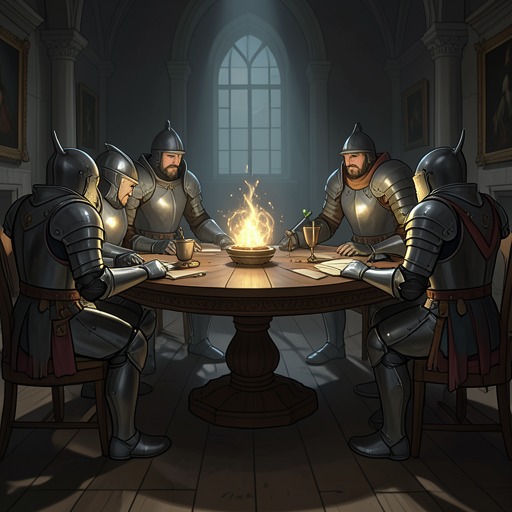
As king, Galahad orders a chest of gold and precious stones to be made around the silver table, covering the Grail. He and his companions come before it each morning to pray. His rule is therefore represented through care for the holy vessel and shared devotion, rather than through political conquest. The city’s change of ruler also prepares the final revelation: the year of Galahad’s kingship leads directly to the return of Joseph of Arimathea and the end of the Grail’s visible presence in the world.
Revelation and departure
On the anniversary of Galahad’s coronation, the companions see the Grail before them and a bishop-like figure surrounded by angels. He celebrates the Mass of Our Lady and calls Galahad forward to see what he has long desired. Galahad trembles as mortal flesh beholds spiritual things, receives the sacrament, and declares that he would not wish to live longer if it pleased God. The figure identifies himself as Joseph of Arimathea, sent to accompany Galahad because Galahad resembles him in having witnessed the Grail’s marvels and in being a clean maiden.
Galahad takes leave of Percivale and Bors, asks them to greet his father, Sir Launcelot, and kneels in prayer before the table. His soul departs, and a company of angels carries it to heaven. The two surviving companions then see a hand descend from heaven and take up the Grail and the spear; they do not see the body of the hand. The account concludes that from then on no one dared say that he had seen the Grail. Sarras is consequently the place where the Quest’s movement toward the sacred ends not in a return to Arthur’s court by Galahad, but in his death, the departure of the holy objects, and the closing of access to their vision.